
Biofilms are structured microbial communities embedded within a self-produced extracellular polymeric substance (EPS) matrix that adhere to surfaces in aqueous environments. Their presence in water systems represents a critical challenge due to their contribution to infrastructure deterioration, water quality degradation, and public health risks. At the same time, biofilms play a beneficial role in engineered biological treatment processes.
This article reviews the mechanisms of biofilm formation, their operational and sanitary implications, and current strategies for their control. Particular attention is given to the limitations of conventional disinfection approaches and the emerging role of continuous chlorination using stabilized (organic) chlorine sources as a more effective method for sustained biofilm management.
Introduction
Biofilm formation is an inherent and often unavoidable phenomenon in both natural and engineered water systems. In distribution networks, industrial water circuits, and storage infrastructure, the persistent development of biofilms presents a multifaceted challenge that extends beyond microbiological control, impacting hydraulic performance, chemical demand, and asset integrity.
Unlike planktonic microorganisms, biofilm-associated cells exhibit increased tolerance to disinfectants and environmental stressors, largely due to the protective properties of the EPS matrix and the complex interactions within microbial consortia. This enhanced resistance complicates conventional treatment strategies, which are frequently based on intermittent dosing or shock disinfection.
As regulatory frameworks tighten and operational efficiency becomes increasingly critical, there is growing interest in treatment strategies that provide consistent disinfectant residuals and improved penetration into biofilm structures. In this context, continuous chlorination approaches—particularly those utilizing stabilized chlorine compounds—are gaining relevance as part of integrated biofilm control programs.
Biofilm Formation and Structure
Biofilm formation begins with the adhesion of planktonic microorganisms to a surface, followed by cellular proliferation and the secretion of extracellular polymeric substances. The EPS matrix, composed primarily of polysaccharides, proteins, lipids, and nucleic acids, forms a hydrated and highly structured environment that anchors the microbial community.
This matrix fulfills several key functions:
- Structural cohesion and surface attachment
- Retention of nutrients and water
- Protection against shear forces and chemical agents
Biofilms are heterogeneous systems, both spatially and functionally, often containing gradients of oxygen, nutrients, and metabolic activity. Microbial communities within biofilms may include bacteria, fungi, algae, and protozoa, interacting through synergistic and competitive mechanisms.
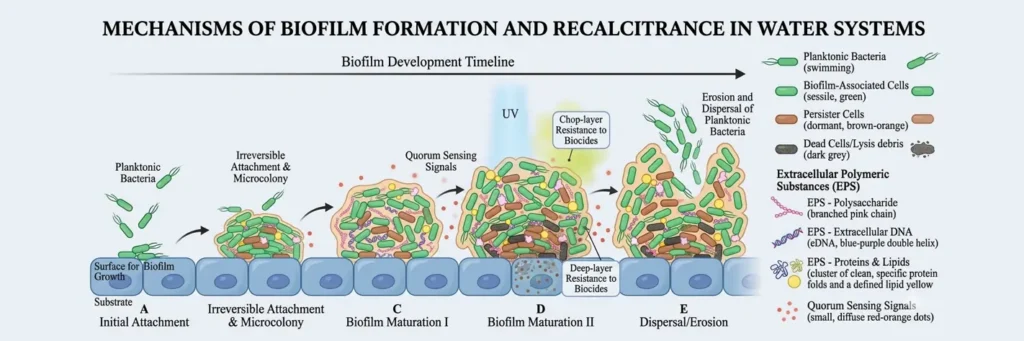
Phases of biofilm formation

Structural composition of a biofilm
Impacts of Biofilms in Water Systems
Operational and Infrastructure Impacts
Biofilm accumulation is a primary contributor to biofouling in water systems. The deposition of biological material on surfaces such as pipelines, membranes, filters, and heat exchangers results in increased frictional resistance, reduced flow capacity, and higher energy requirements.
Microbially influenced corrosion (MIC) is another significant concern. Biofilms create localized microenvironments that facilitate electrochemical reactions, accelerating the degradation of metallic and concrete materials. Sulfate-reducing and acid-producing bacteria are particularly associated with these processes.
In porous media and filtration systems, biofilm growth can lead to clogging and reduced permeability, negatively affecting system performance and requiring more frequent maintenance interventions.
Water Quality Degradation
Biofilms influence water quality through multiple mechanisms. The metabolic activity of microorganisms can produce compounds such as geosmin and 2-methylisoborneol (MIB), leading to taste and odor issues. Additionally, the detachment of biofilm fragments contributes to increased turbidity and color.
The release of extracellular substances and cellular components elevates dissolved organic carbon (DOC) levels, which in turn increases disinfectant demand and may promote further microbial growth within the system.
Public Health Considerations
Biofilms serve as reservoirs for opportunistic and pathogenic microorganisms, including Legionella pneumophila, Pseudomonas aeruginosa, Mycobacterium avium, and Vibrio cholerae. The EPS matrix limits disinfectant penetration, enabling these organisms to persist and, in some cases, proliferate.
Furthermore, biofilms facilitate horizontal gene transfer, contributing to the development and dissemination of antimicrobial resistance. Organic material associated with biofilms also acts as a precursor for disinfection byproducts (DBPs), such as trihalomethanes (THMs) and haloacetic acids (HAAs), which are subject to regulatory control.
Limitations of Conventional Disinfection Strategies
Conventional biofilm control strategies are typically based on the application of oxidizing agents, such as free chlorine or monochloramine, often delivered through intermittent or shock dosing. While these methods can reduce planktonic microbial populations, their effectiveness against established biofilms is limited.
Key limitations include:
- Restricted penetration of disinfectants into the EPS matrix
- Rapid decay of disinfectant residuals in the presence of organic matter
- Sensitivity of chlorine efficacy to pH variations
- Inconsistent exposure of biofilm communities to active disinfectant concentrations
Optimal disinfection requires maintaining a pH range between 7.2 and 7.6, where hypochlorous acid (HOCl) predominates. However, many conventional chlorine sources can alter system pH, reducing treatment efficiency.

Continuous Chlorination with Stabilized Chlorine Sources
Continuous chlorination strategies have emerged as a more effective approach for biofilm control, particularly when combined with stabilized (organic) chlorine compounds. These systems provide a sustained release of free available chlorine, allowing for prolonged interaction with the biofilm matrix.
The gradual exposure to consistent disinfectant levels facilitates:
- Progressive weakening of the EPS structure
- Improved diffusion of disinfectant into deeper biofilm layers
- Enhanced inactivation of embedded microorganisms
An important operational advantage of stabilized chlorine systems is their ability to maintain more consistent water chemistry conditions, minimizing fluctuations in pH and supporting optimal disinfection performance.
Continuous dosing approaches also reduce the need for aggressive shock treatments, contributing to more stable system operation and potentially lower long-term chemical consumption.
Integrated Approach to Biofilm Control
Effective biofilm management requires a comprehensive and system-specific approach, including:
- Hydraulic characterization of the system to identify low-flow zones and potential biofilm accumulation areas
- Water quality assessment, including pH, alkalinity, hardness, and organic carbon
- Microbiological evaluation to determine biofilm presence and composition
- Physical cleaning and system preparation
- Optimization of water chemistry parameters
- Controlled application of disinfectants, with emphasis on maintaining consistent residuals
- Continuous monitoring and verification of treatment performance
For biofilm penetration, free chlorine concentrations in the range of 5–10 ppm over extended contact periods (72–96 hours) are commonly referenced, depending on system conditions.
Monitoring and Detection Challenges
The detection and quantification of biofilms remain technically challenging due to their heterogeneous distribution and inaccessibility. Monitoring approaches can be broadly categorized as:
- Direct methods: biofilm coupons, microscopy, ATP analysis
- Indirect methods: pressure drop monitoring, tracer studies, molecular techniques
Despite advances in analytical methods, early detection and real-time monitoring remain areas requiring further development.
Discussion
The persistence of biofilms in water systems underscores the limitations of conventional, reactive treatment strategies. Increasingly, the focus is shifting toward preventive and continuous control methodologies that address the structural resilience of biofilms rather than solely targeting planktonic microorganisms.
Continuous chlorination using stabilized chlorine sources represents a promising approach in this context, as it aligns with the need for sustained disinfectant exposure and stable water chemistry conditions. When integrated into a broader operational framework, this strategy can improve treatment reliability and reduce system variability.
Conclusion
Biofilms are a critical factor influencing the performance, safety, and longevity of water systems. Their control requires a nuanced understanding of microbial ecology, system hydraulics, and chemical treatment dynamics.
While traditional disinfection methods remain relevant, their limitations in addressing established biofilms necessitate the adoption of more advanced approaches. Continuous chlorination strategies, particularly those based on stabilized chlorine compounds, offer a viable pathway toward more effective and sustainable biofilm management.
Future developments in monitoring technologies and treatment optimization will be essential to further enhance control strategies and ensure the safe and efficient operation of water systems.